

Solutions
Our passionate and experienced people deliver successful clean energy projects globally.
Technologies
Driving a clean energy future through state-of-the-art renewable technologies.
See all technologiesResources
Browse our latest resources, including company updates, customer stories, industry insights, and research reports.
See all resourcesCareers
Join a collaborative team of passionate individuals who engage in meaningful, stimulating, and world-changing work.
Learn moreAbout RES
We live our mission, celebrate the people making it happen and transform the way the world produces and consumes energy.
See about usOur offices
Like our business, we’re truly global – but proudly local. Find contact and location details for every RES office.
Contact us-
Home
/
Resources
/
Case Studies
/
Scaling below the surface: Turbine foundations for the next generation of onshore wind
Scaling below the surface: Turbine foundations for the next generation of onshore wind
by RES | Mar 09, 2026 | Reading time: 2 min
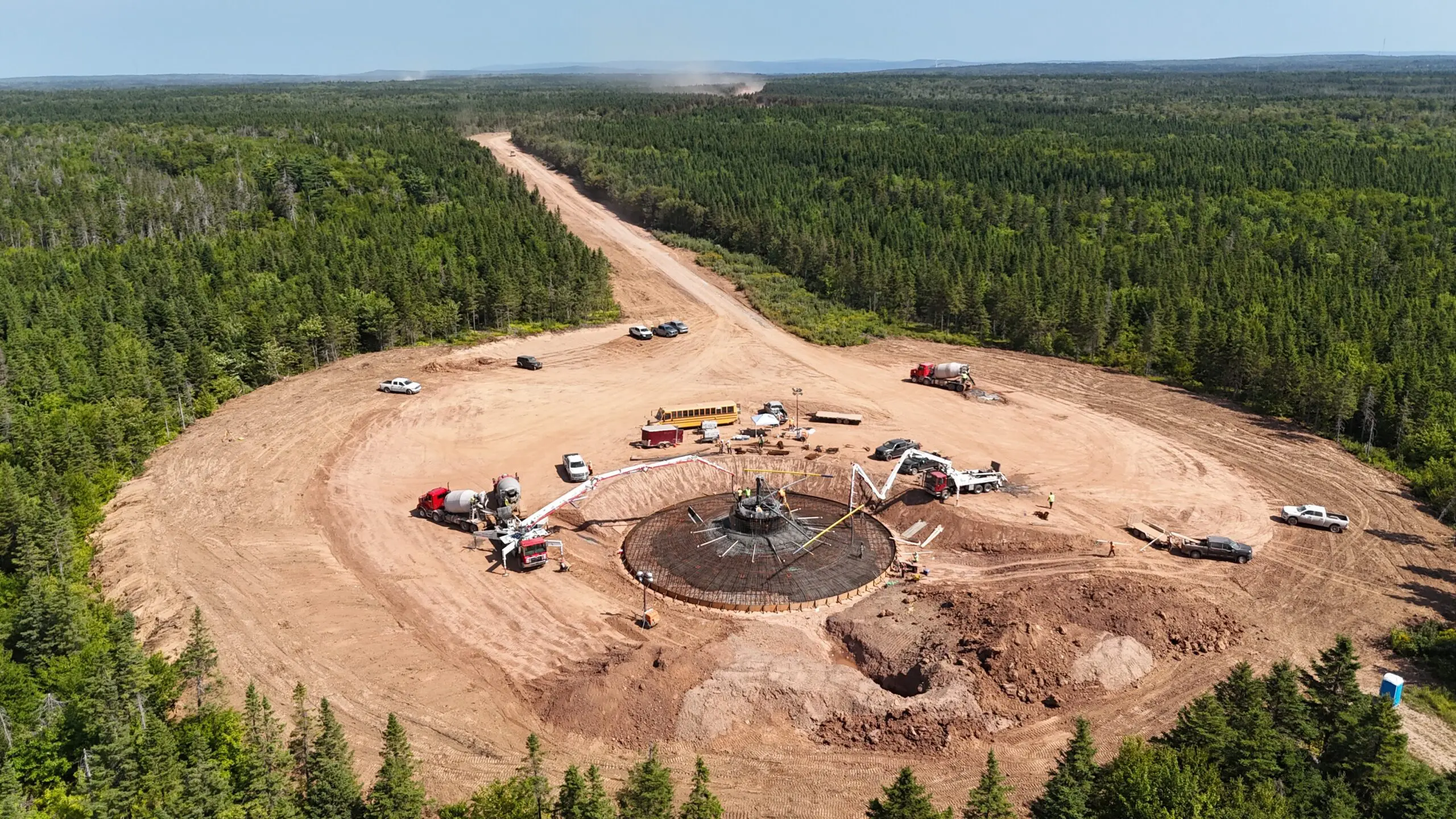
As onshore wind turbines continue to grow taller and more powerful, much of the industry’s focus is on what’s visible above ground – towers, blades and energy output. Less obvious but equally critical are the challenges below the surface, where foundations must carry heavier loads, adapt to complex site conditions, and be delivered safely at scale.
In the past 15 years, turbine ratings have grown from under 1MW to more than 7MW. Rotor diameters have increased by over 50 percent, and hub heights have risen from roughly 70 metres to more than 100 metres. These changes create a multiplier effect for foundations, which must now resist higher overturning moments and embed complex reinforcement layouts to ensure long-term stability.
The Goose Harbour Lake Wind Farm in Nova Scotia provides a clear example of how these challenges are being met. The 168MW project features turbines with 108-metre hub heights and 170-metre rotor diameters. Foundations span 28 metres in diameter and are designed to withstand overturning loads exceeding 156,000 kNm. In addition, the team had to manage shallow groundwater, high-density rebar layouts and excavations that frequently encountered bedrock, each of which added construction risk.
Integrated design and adaptive construction
To meet these challenges, RES implemented an integrated engineering and construction approach. Engineering teams across North America and the UK collaborated from the outset, developing gravity-based foundations that resisted buoyancy forces while remaining constructable on site. Early contractor input informed adjustments to rebar layouts and conduit routing, reducing congestion and improving sequencing during concrete pours.
Concrete placement for each foundation involved approximately 900 cubic metres poured over 12 hours, requiring careful planning, crew rotations and fatigue management protocols to ensure safety and precision. Adaptive water management, including sump pits, French drains, and temporary ditching, controlled groundwater during excavation and pouring. Bedrock encountered during excavation was blasted and levelled efficiently to maintain the project schedule, demonstrating how real-time problem solving can keep large projects on track.
Delivering outcomes and lessons
The outcome demonstrates the value of early collaboration and adaptive delivery. Foundations were completed on schedule, met all structural specifications, and were installed safely, despite complex site conditions. Engineering approved field adjustments and iterative coordination prevented potential rework, optimised resource use and ensured quality.
Lessons from Goose Harbour Lake provide a blueprint for scaling onshore wind foundations:
- Integrate engineering and construction early to reduce risk and improve constructability
- Plan ahead for site-specific challenges such as groundwater, rebar density, and bedrock
- Use structured sequencing and workforce planning for long-duration concrete pours
- Engage clients in transparent coordination to improve decision-making and confidence
Looking ahead, these practices will be critical as turbines continue to scale. Foundations are no longer just a supporting element; they are a key factor in project risk, schedule certainty and long-term performance. Projects that anticipate these challenges and embed collaboration, adaptability, and innovation from the start will be better positioned to deliver safely, efficiently, and reliably.
Goose Harbour Lake shows that when engineering innovation meets construction excellence, complex foundations can be delivered at scale, providing a model for the next generation of onshore wind projects.
Share this article


28m
foundation diameter
900m³
concrete per foundation
156,000 kNm
overturning load
12+
hours per concrete pour

Having been with RES since our first project in Canada, being at the forefront of these technological advancements in construction fills me with pride as we continue to lead the industry.
Liam Duffy, Senior Vice President, Canada EPC